
Carney government should expand Canada Housing Benefit
La version française de ce billet se trouve ici.
Canada’s National Housing Strategy (NHS) is set to expire in March 2028. As various orders of government seek to negotiate a refresh of the original 10-year strategy, it’s important to apply learnings from the first one.
One such learning is that the Canada Housing Benefit (CHB) can be effective at reducing homelessness in communities where it’s well-targeted. The federal government should build on this success and expand the CHB.
At no time in the post-Depression era has Canada seen more homelessness than today. According to the most recent National Shelter Study, there were nearly 5,000 more people sleeping in emergency shelters in 2024 than there were in 2019. The same report found that average length of stay is increasing – nearly doubling between 2005 and 2024.
Not surprisingly, Canada has also seen a significant rise in chronic (i.e., long term) homelessness – roughly a 10 per cent increase between 2023 and 2024.
Many of us hoped that rising outdoor sleeping seen during the pandemic would be temporary. It wasn’t. According to national data-collection efforts, there was nearly 80 per cent more outdoor sleeping in 2024 than there was during the 2020-2022 period.
What is truly needed is a well-funded national strategy with aggressive targets for new non-market housing. Such new funding can target key neighbourhoods, create units that are appropriate for specific tenant vulnerabilities (e.g., physical disabilities), and result in buildings with appropriate space for staff support and community development.
Non-market housing can also keep rent levels low over the long term, essentially providing an organic form of rent control.
And some tenants need ongoing professional staff support once housed – in the sector, we call this ‘wraparound support.’
We also need evidence-based approaches to address the overdose crisis. That means listening more to experts – including people with lived experience – and not using the crisis as a political wedge issue.
More robust income assistance programs would also help immensely. Today, social assistance (i.e., welfare) benefit levels are far too low for most recipients to afford decent housing.
In November 2017, the federal government released its much-anticipated National Housing Strategy. Central to the Strategy was the announcement of a newly created CHB consisting of financial assistance to help low-income households afford rent.
The CHB was initially estimated to cost $4 billion over eight years, with half of the cost coming from the federal government and the other half coming from provincial and territorial governments.
The 2021 federal budget announced an additional $315.4 million over seven years for the CHB, beginning in 2021-22. And in September 2022, the federal government announced a one-time $500 top up to the CHB for some individuals, in order to help with inflation.
In most parts of Canada, the CHB has been targeted to a combination of households experiencing homelessness and to households at risk of experiencing homelessness. Several provinces have incorporated it into existing housing affordability schemes – and have (hopefully) not used it as a substitute for previous provincial or territorial funding.
In Ontario, the CHB – known as the Canada Ontario Housing Benefit (COHB) – is administered by municipalities with provincial oversight. Each municipality is given some latitude in terms of which low-income people ultimately receive the benefit.
In recent years, the City of Toronto has targeted much of the benefit to people in its emergency shelter system, with each recipient household receiving approximately $1,000 monthly. Every year, the Province advises the City of its allocated funding amount.
The CHB has been wildly effective at housing people directly out of Toronto’s shelter system. When it’s available to municipal officials, it helps move people directly into housing. When it’s not available, flow out of the shelter system is sluggish.
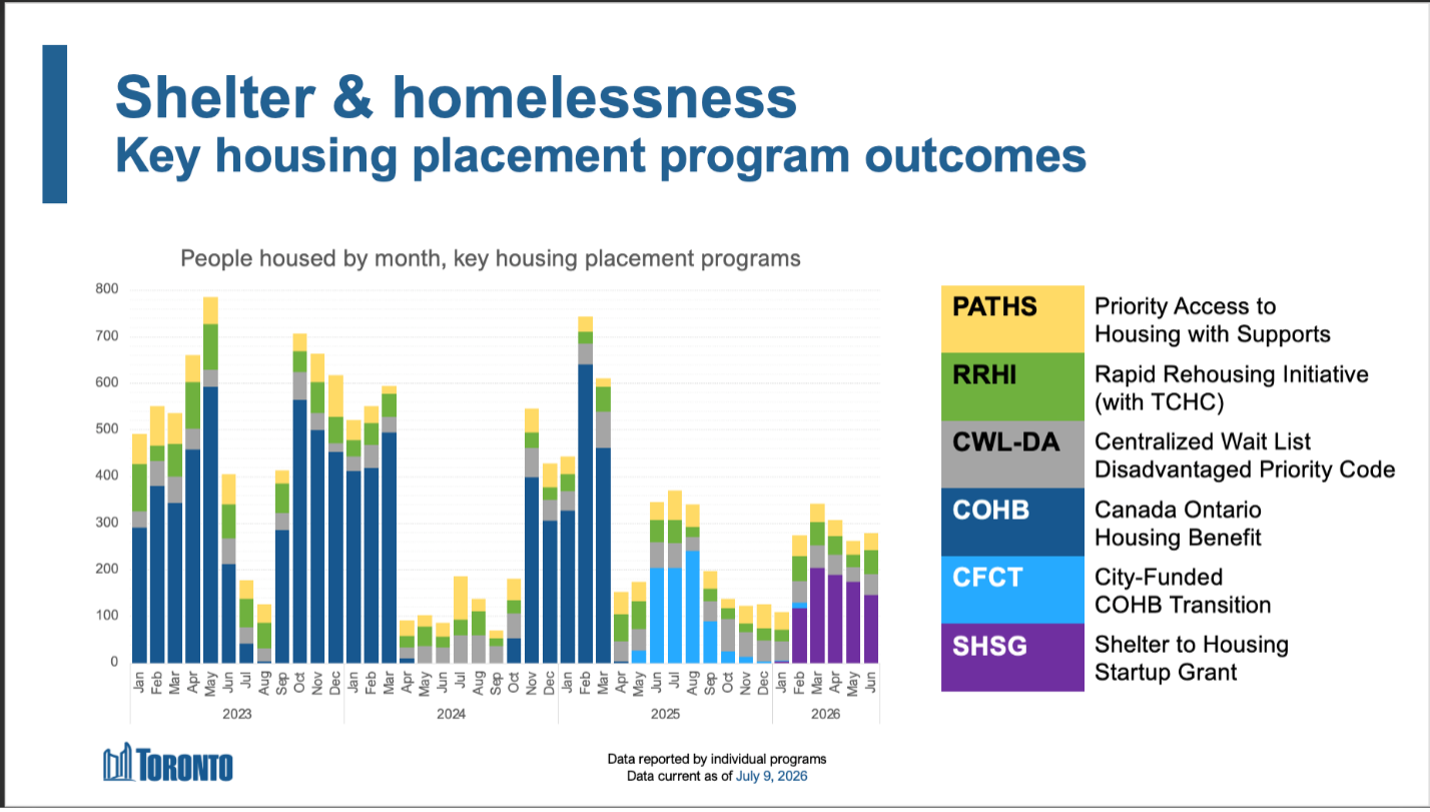
*See notes below for explanations of each initiative mentioned in this visual.
Not every province and territory is rolling out the CHB in the same way. The benefit’s interaction with existing income support programs is complicated, and there are ongoing debates over which households should be prioritized.
In the words of a recent Maytree report: “Some jurisdictions must ration the support they provide, causing intake to stop for months at a time when the money runs out.”
Even in Ontario, the approach is far from perfect. Toronto’s annual allocation has decreased significantly in recent years, and it flows at a stop-and-go pace, often forcing municipal officials to rush implementation.
But when it’s in place, take up is very strong, allowing low-income persons to use it to move out of emergency shelter into housing.
Indeed, Toronto’s recent experience shows that people leave the shelter system when the CHB is in place. Other programs help, but not to the same extent.
CHB has been the game changer in Toronto. Without it, there is very little movement out of emergency shelters.
Various organizations – including the Canadian Alliance to End Homelessness and Maytree – have made proposals to improve the program. Those proposals should be heard. But in the meantime, CHB is a very important foundation upon which to build.
The CHB hasn’t ended homelessness. Canada needs an extensive suite of well-funded programs in order to properly address it. But in the meantime, Toronto’s experience shows us that the CHB is one of them.
I wish to thank Kathleen O’Grady, Annick Torfs and several anonymous reviewers for assistance with this opinion piece.
*PATHS refers to Priority Access to Housing with Supports. This is a program for people currently coming through Toronto’s Coordinated Access system. People are prioritized from a By-Name List and then housed in non-market housing with a deep rental subsidy. The person receives wrapround supports once housed.
RRHI refers to Rapid Rehousing Initiative. With this initiative, people are housed in units operated by either Toronto Community Housing or Toronto Seniors Housing Corporation (the units in question have a deep rental subsidy). Recipients must be on Toronto’s By-Name. Some beneficiaries of this initiative receive wrapround supports, once housed.
CWL-DA refers to Centralized Wait List Disadvantaged Priority Code. This is available to people experiencing homelessness who are also on the City’s centralized non-market housing waiting list. Recipients have a “DA code,” which stands for ‘disadvantaged’ (one of several priority streams through the centralized waiting list).
CFCT refers to City-Funded COHB Transition. Through this initiative, the City funds a few months of a benefit in order to transition a person into COHB. The person in question would have been formally approved to receive the COHB, and the City would fund them in this way temporarily until such time that COHB funds become available.
SHSG refers to the Shelter to Housing Start up grant (a new initiative). This provides a one-time grant that covers such items as first and last month’s rent, furniture, etc. In order to receive the SHSG, a person must have experienced homelessness for at least six months, have secured a Promise of Address, and demonstrate that they have sufficient income to maintain a tenancy.